Skateboarding Basics
The foundation of every complex trick is the ability to roll comfortably. If you cannot ride to the local store without stepping off, you are not ready to kickflip.
Discovering Your Stance
Before you step on a board, you must identify your natural stance. In skateboarding, there are two primary stances: Regular and Goofy. Regular riders place their left foot forward near the front truck, using their right foot to push. Goofy riders place their right foot forward and push with their left. Neither stance provides a mechanical advantage; it is entirely dependent on your individual balance and body mechanics.
A common method for determining your stance is the "slide test." Run and slide on a smooth floor in your socks. Whichever foot naturally extends forward to catch your balance is likely your leading foot on a skateboard. Alternatively, stand straight and have someone gently push you from behind. The foot you step forward with to brace yourself is your front foot.
The Art of Pushing
Pushing is often overlooked as a fundamental skill, resulting in beginners adopting the notorious "mongo" push. Mongo pushing occurs when a rider leaves their back foot on the board and pushes with their front foot. While some professionals can ride mongo switch, it fundamentally destabilizes your center of gravity and delays the setup time for tricks. Always aim to push with your back foot.
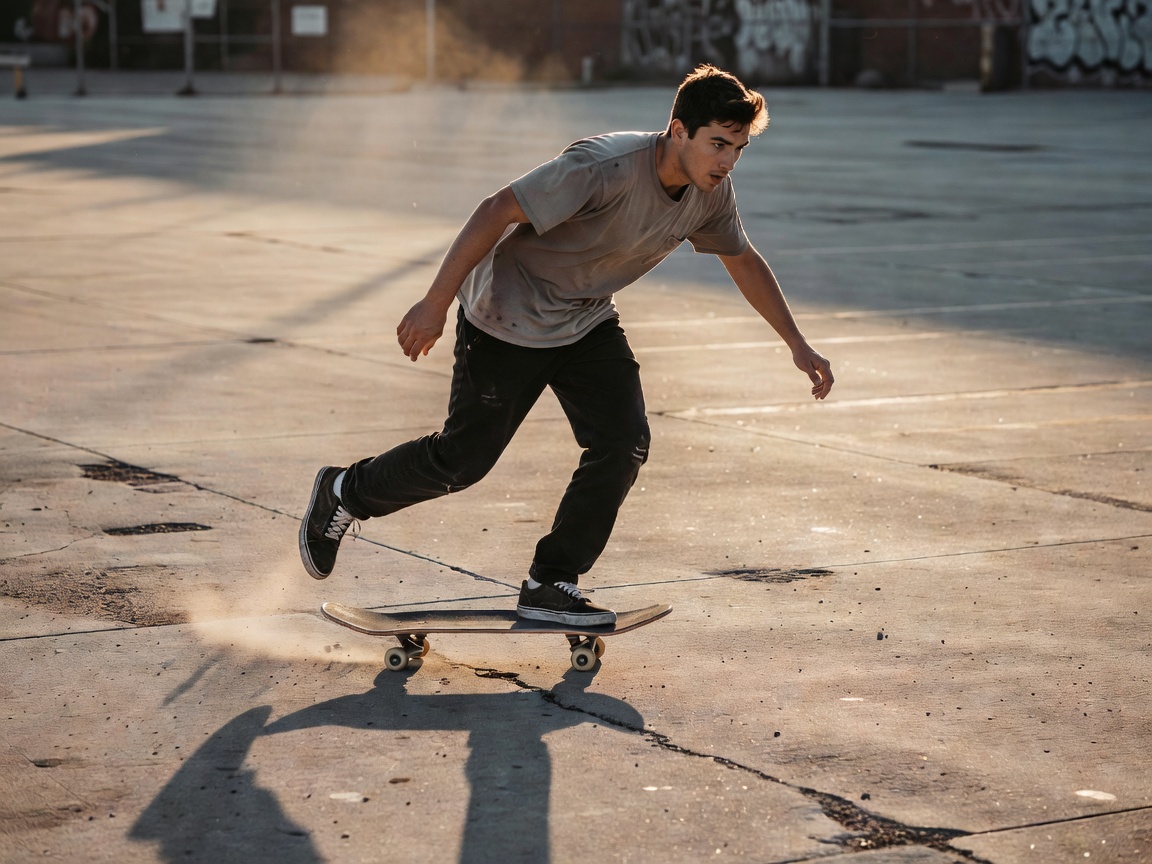
Place your front foot over the front hardware, toes pointing forward. Bend your front knee slightly—this lowers your center of gravity and increases stability. Reach forward with your pushing foot, plant it on the pavement, and drive backward smoothly. Once you reach your desired speed, pivot your front foot so it rests perpendicular to the deck, and bring your back foot up to rest across the rear trucks or tail.
Carving and Kickturning
Once moving, you must learn to navigate. Turning relies on two mechanics: carving (leaning) and kickturning. Carving is achieved by loosening your trucks and leaning your body weight onto your toes or heels. This engages the bushings in the trucks, allowing the board to arc smoothly without lifting the wheels. It is essential for navigating subtle curves and pumping for speed in a bowl.
When you need to make a sharp adjustment, the kickturn is required. Apply slight pressure to the kicktail to lift the front wheels marginally off the ground. Simultaneously, swing your shoulders and hips in the desired direction. The board will follow your momentum. Mastering kickturns on flat ground translates directly to executing kickturns on banks, ramps, and transition surfaces.
Stopping and Bailing
Understanding how to stop safely prevents serious injury. The most reliable method for beginners is the foot brake. To execute this, remove your back foot from the board and drag the sole of your shoe flat against the ground, gradually applying more pressure until you come to a halt. Avoid dragging the heel alone, as this will destroy your shoes rapidly and provides less stopping power.
Equally important is the ability to fall. Bailing gracefully is a necessary survival skill in skateboarding. When you lose balance, do not stiffen your limbs to brace for impact; this frequently results in fractured wrists. Instead, aim to roll out of the momentum. Tuck your chin to your chest, keep your elbows slightly bent, and allow the kinetic energy to dissipate across the broader surfaces of your shoulders and back.