Essential Tricks Breakdown
Progression in skateboarding relies on a compounding skill tree. The mechanics of the simplest trick unlock the gateway to complex variations. We break down the physics and exact foot positioning required to elevate your board.
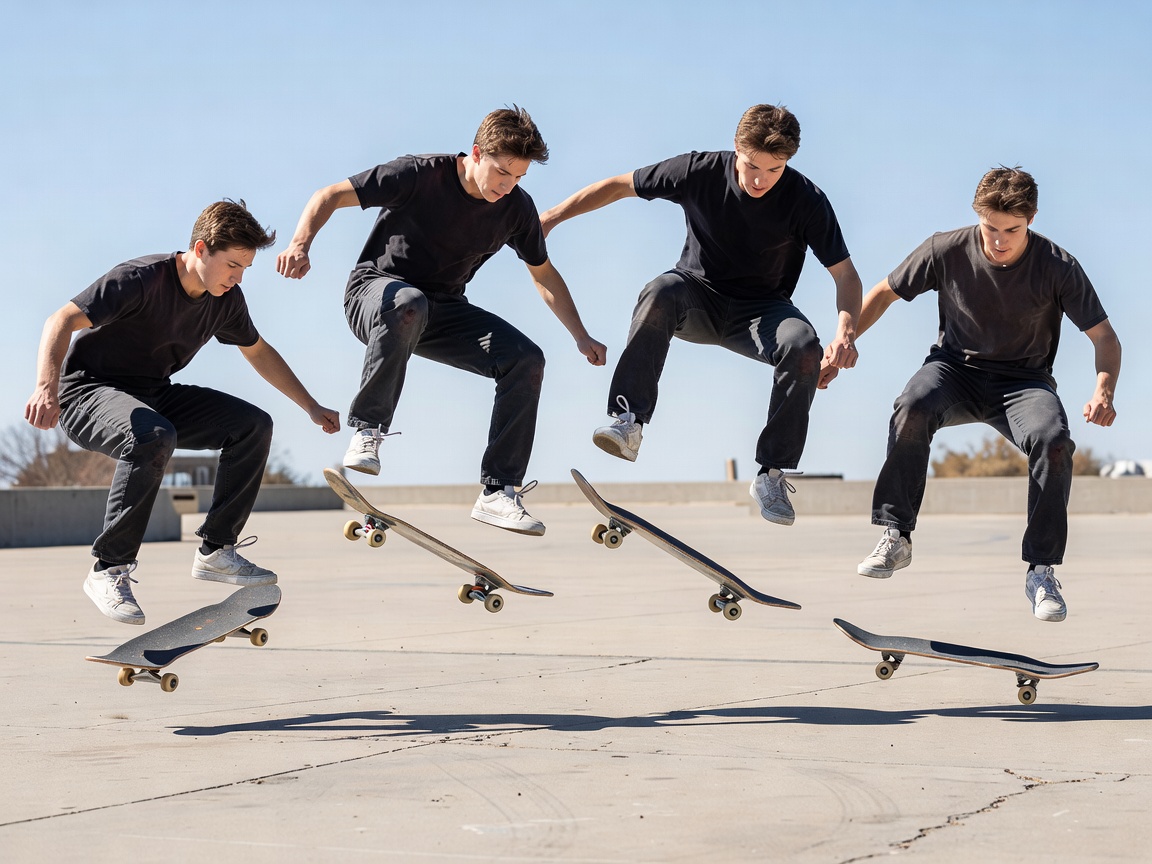
The Ollie: The Foundation of Flight
Invented in the late 1970s and adapted to flat ground shortly after, the ollie is the most critical maneuver in modern street skating. It allows the rider and board to become airborne as a single unit without the use of hands. The mechanics rely on a sequence of rapid kinetic shifts: pop, drag, level, and land.
Place your back foot squarely on the tip of the tail and your front foot directly behind the front truck bolts. Crouch to load kinetic energy. The movement begins with an explosive downward thrust from the back ankle—not the entire leg—driving the tail into the pavement to create a sharp "pop." As the tail strikes the ground, your weight must already be lifting upward. Immediately roll your front ankle inward and drag the abrasive side of your shoe up the grip tape toward the nose. This friction pulls the back wheels off the ground and levels the board horizontally in mid-air. Allow gravity to carry you down, bending your knees upon impact to absorb the shock.
The Shove-It and Pop Shove-It
The shove-it involves rotating the board 180 degrees beneath your feet without flipping it on its horizontal axis. A standard shove-it requires no pop; it is entirely a scooping motion. Position your back foot with the toes hanging slightly over the edge of the tail. With a quick backward scoop of the back foot, push the tail behind you while simultaneously performing a small vertical hop. Keep your front foot hovering slightly above the board to catch it once the 180-degree rotation completes.
A pop shove-it applies the same scooping mechanic combined with the violent downward snap of an ollie. This launches the board higher into the air, allowing you to clear obstacles or execute the maneuver into grinds.
The Kickflip: Mastering the Flick
Once the ollie and pop shove-it are solidified, the kickflip is the next benchmark. The kickflip demands that the board rotate 360 degrees along its longitudinal axis beneath the rider. The setup mirrors the ollie, but the front foot is placed slightly farther back and angled at roughly 45 degrees, toes pointed toward the nose.
Execute the pop just as you would for an ollie. However, instead of sliding your front foot straight up the center of the board, drag it diagonally toward the pocket (the curved recess where the nose begins). The final motion is a sharp "flick" of the ankle off the corner of the deck. This lateral friction initiates the spin. The most common error is kicking down toward the ground, which pins the board and prevents rotation. You must flick up and out, pulling your knees high to allow the deck space to spin completely before stomping down on the bolts.
Transition Fundamentals: Dropping In
Tricks are not confined to flat ground. Transition skating—riding ramps, bowls, and quarterpipes—requires its own fundamental skill: the drop-in. Dropping in is highly psychological; hesitation results in the board shooting out from beneath you.
Place the tail of your board firmly on the coping (the metal pipe at the top of the ramp), with your back wheels hanging over the edge. Step your back foot solidly onto the tail. To initiate the drop, place your front foot over the front bolts and slam your weight forcefully forward into the transition. Your body must be perpendicular to the angle of the ramp, not upright relative to gravity. Stomp the front wheels down until you hear them connect with the concrete or wood, and ride away smoothly.